Why this topic caught my attention
My interest in embedded systems did not start from theory alone. It came from wanting to understand the devices and machines around me at a deeper level. When I look at robots, sensors, controllers, or even simple hardware projects, I do not just see components. I see a system that has to sense, decide, and act in the physical world.
That is why embedded systems feel important to me as a robotic enthusiast. They connect software to hardware in a way that is practical, constrained, and very close to reality.
What embedded systems are
An embedded system is a computer built to do a specific job inside a larger product. Unlike a laptop or desktop, it is usually designed around one function, tight constraints, and a predictable environment. That can mean a sensor node, a motor controller, a smart appliance, a wearable device, or the electronics inside a robot.
The important part is not just that it runs code. It is that the code must work with hardware, timing, power, memory, and physical inputs at the same time. That is what makes the field interesting and sometimes difficult.
Embedded systems vs computing systems
A general-purpose computing system is built to serve many tasks. It is flexible by design, and users can change what it does almost every day. An embedded system is narrower. It is built to be reliable, efficient, and often invisible.
- Computing systems optimize for flexibility and broad software support.
- Embedded systems optimize for task-specific behavior, timing, and control.
- Computing systems can usually afford more memory and power.
- Embedded systems often work under strict limits and real-world conditions.
That difference matters because the engineering mindset changes. In embedded work, I am not only thinking about code. I am also thinking about sensors, actuators, communication buses, power budgets, and the physical system around the software.
Why the challenges matter to me
Embedded systems matter because they force me to connect theory with reality. Limited processing power, memory pressure, noisy inputs, hardware bugs, and timing issues can all shape the final result. That is frustrating at times, but it is also what makes the work meaningful.
I like the fact that embedded systems are honest. If something is wrong, the problem usually shows up in the behavior of the physical system. That pushes me to slow down, debug carefully, and understand the whole chain from software to hardware.
How I started learning
I started learning by combining structured study with small experiments. Courses gave me the vocabulary and the concepts, but hands-on work is what made the ideas stick.
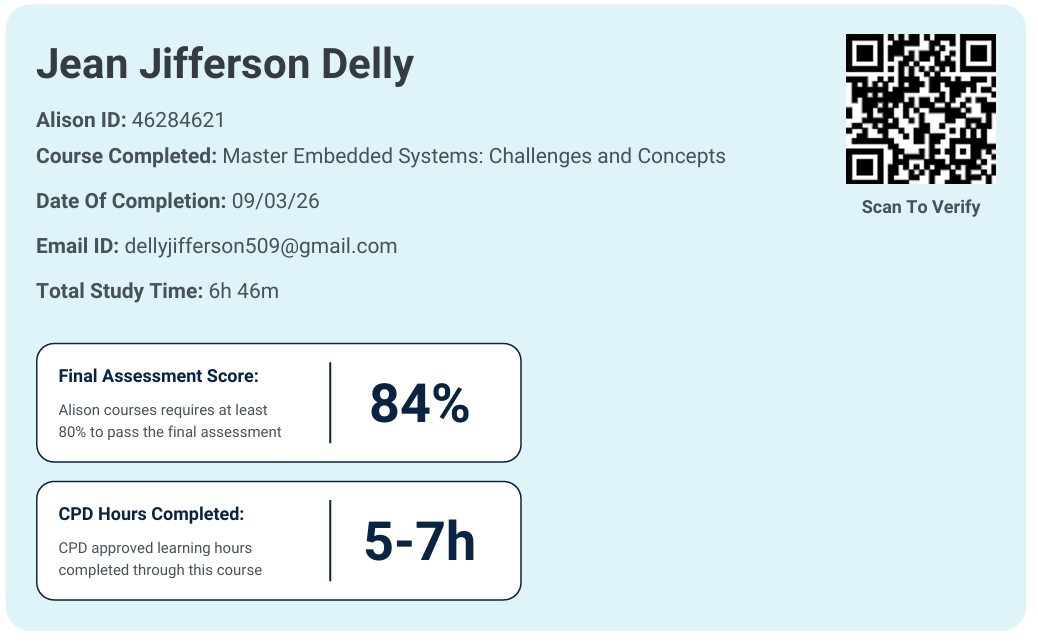
- I studied online material to understand terminology, architecture, and tradeoffs. Specially on Alison and Coursera
- I read documentation, articles and datasheets to see how components behave in practice.
- I tried small projects with microcontrollers, sensors, and control logic.
- I debugged code and wiring together, because both usually matter at the same time.
- I compared embedded behavior with the general-purpose systems I already knew from computer science.
One thing I want to add later is more detail about my first real experiments and the problems that forced me to learn faster. That is where the story becomes mine, not just a definition of the field.
Embedded systems feel like the right move to me because they sit at the intersection of software, hardware, and purpose. That combination keeps pulling me forward, and I expect this series to grow as I keep learning.